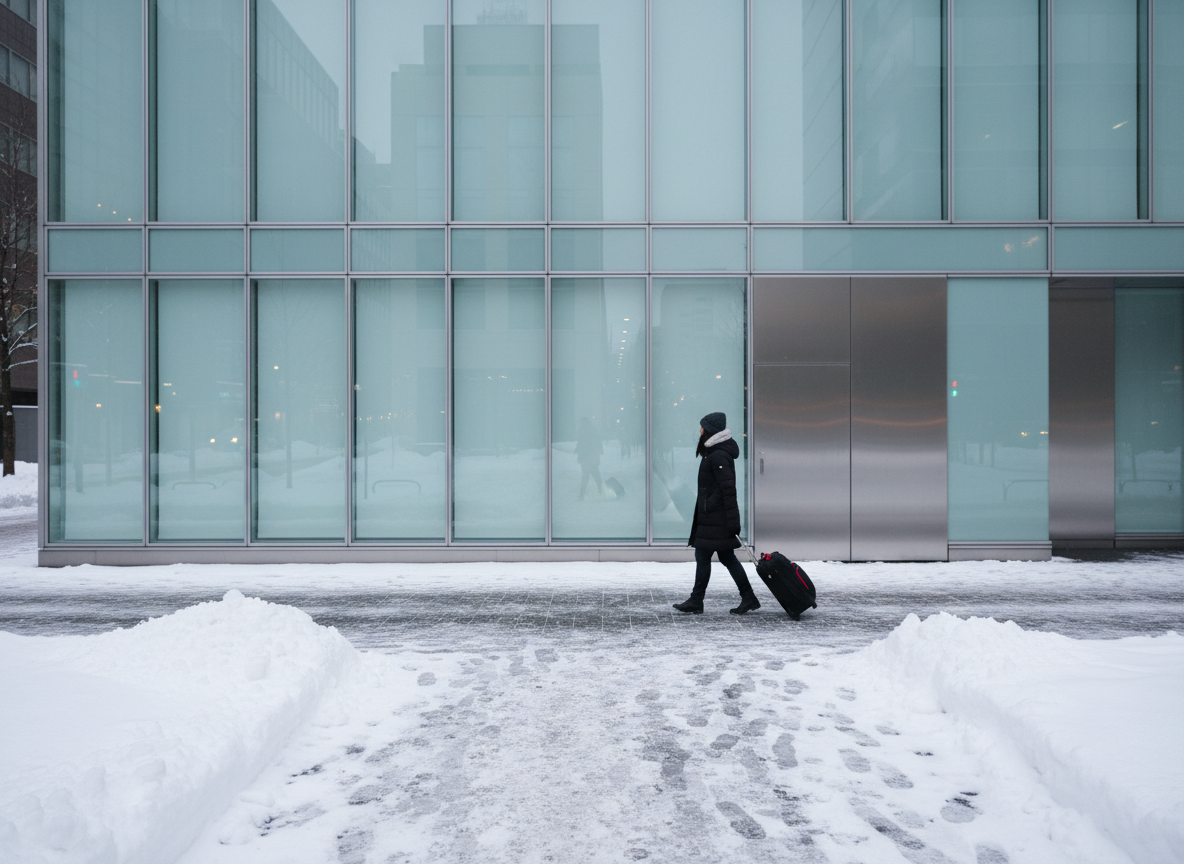
If your hotel is listed as a 5-minute walk from a station in Sapporo, that can still be a useful starting point. In winter, though, the real effort can be very different from a snow-free day.
Snow and ice, uneven or narrowed sidewalks, rolling luggage, stroller use, stairs, elevator detours, and a final outdoor segment after leaving the underground network can all change how easy that short walk feels. There is no reliable universal multiplier, so it is better to treat the map time as a baseline and check the actual route before booking.
Why a short walk can feel longer in winter
A map-listed walking time does not tell you what the pavement will be like that day. In Sapporo, winter routes can include compacted snow, ice, slush, snowbanks, or uneven surfaces. Official Sapporo visitor guidance specifically warns that frozen winter roads can be slippery and recommends small steps, winter footwear, and anti-slip products when needed.
The practical question is therefore not only, “How many minutes does the map show?” It is also, “What will I be carrying, which exit will I use, and how much of the route is actually outdoors?”
Snow and ice underfoot
Sapporo’s official visitor information advises extra care on frozen surfaces. De-icing agents are used around JR stations, subway stations, and other busy public facilities, but that does not mean every part of every route will be treated. The city also provides practical advice such as lowering your center of gravity, taking small steps, using suitable winter footwear, and adding anti-slip spikes or cleats if necessary.
The risk is not theoretical. Sapporo Fire Bureau reported 2,060 ambulance transports caused by self-falls on snowy or icy roads in FY2025 (Reiwa 7). The figure is a citywide, all-ages preliminary total as of March 31, 2026, not a tourist-specific statistic. It is useful mainly as context for why winter walking deserves more planning than a normal city walk.
Rolling a suitcase on snow
From local firsthand experience, a suitcase that rolls easily through an airport or station can become much harder to move once its wheels meet packed snow, ruts, slush, or uneven winter pavement. Wheels can catch or drag, and narrow paths can make it harder to walk beside the case comfortably.
This does not mean you should avoid a hotel simply because it is a few minutes from the station. It does mean that arrival day deserves more attention than the same route later in your stay, after your bags are already at the hotel.
Stairs vs. elevator detours
Sapporo’s subway system provides elevator access at stations including Sapporo and Odori, but not every individual station exit has an elevator. If you are carrying heavy luggage, using a stroller, or have mobility needs, the closest exit on a map may not be the most practical one.
Before relying on a route, check the current official station or exit map and identify the elevator route you actually plan to use. A slightly longer indoor route can be easier than reaching the nearest exit and discovering stairs at the end.
Why “underground access” does not always mean door-to-door indoor access
Central Sapporo has an extensive underground pedestrian network, but it is made up of different facilities and sections.
Chi-Ka-Ho, the Sapporo Ekimae-dori Underground Walkway, is an official underground pedestrian space of about 520 meters linking the Subway Sapporo Station and Odori Station area. South of Odori, Pole Town is a separate underground shopping street that runs for about 400 meters toward Susukino Station.
Together with other underground connections, these facilities make it possible to cover a large part of central Sapporo indoors. But “underground access” does not automatically mean that your hotel entrance is directly connected to the network.
Some buildings are directly linked. Others require you to come back to street level and walk a final outdoor section. That distinction matters much more in winter than it does in summer, especially with luggage or young children.
Traveling with kids or a stroller
Indoors, a stroller can be very convenient. Underground passages, department stores, and stations can provide a protected route away from snow and ice.
Outdoors, the situation can change quickly. From local firsthand experience, narrowed or uneven winter sidewalks can make stroller pushing much harder than in summer. A baby carrier can be a useful backup for short outdoor sections when the stroller becomes impractical.
The same route can therefore feel very different depending on whether you are traveling alone, carrying luggage, or trying to manage a stroller and a child at the same time.
Arrival day vs. after you have dropped your bags
Arrival day is a separate planning problem.
A short station-to-hotel walk can feel much more demanding when you are handling suitcases, helping children, checking directions, and navigating an unfamiliar winter route all at once. After check-in, the same neighborhood may feel easy because you are moving around without luggage.
When choosing between two hotels, it can therefore be useful to judge the arrival route separately from the hotel’s general sightseeing convenience.
If you’re still deciding where to stay, compare Sapporo Station, Odori, and Susukino before booking your hotel.
A practical pre-booking checklist
Before booking a hotel based on a short walking time, check:
- Is the hotel directly connected to an underground passage, or is there a final outdoor section?
- If you will use a station exit, which current exit has elevator access?
- Does the route include stairs or street crossings?
- How much of the route is outdoors?
- Will you be carrying rolling luggage on arrival day?
- Are you traveling with a stroller or young children?
- Would a slightly longer indoor route be easier than the shortest route on the map?
A “5-minute walk” can still be perfectly reasonable in Sapporo winter. The point is not to distrust the map. It is to check what those five minutes actually contain.
Leave a Reply